 Education with Aloha
Workbooks for grades 9–12 built on real investigations and real data. Twenty-plus case files, two hundred one-page daily warm-ups, unit assessments, a semester exam, and a complete answer key. No lectures, no videos, no prep.
Each book is twelve units. A unit opens with one or two case files and then runs about sixteen school days of warm-ups. The pattern never changes, so after the first week the student doesn't need instructions and the parent doesn't need to prepare.
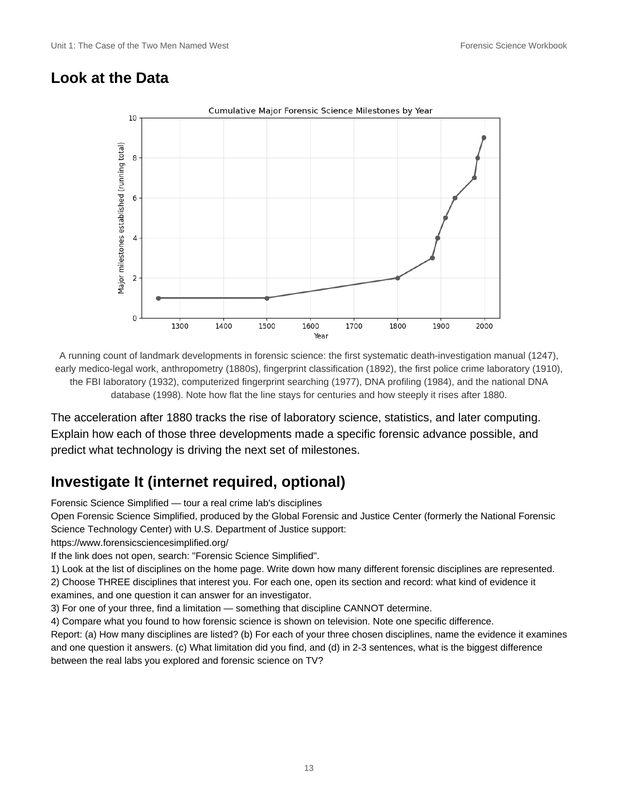
A real investigation, told as a story, with the science or the data behind it. Each case ends with questions that double as the unit test, including a graph of real data to interpret and a short Investigate It task that sends the student to the primary source.
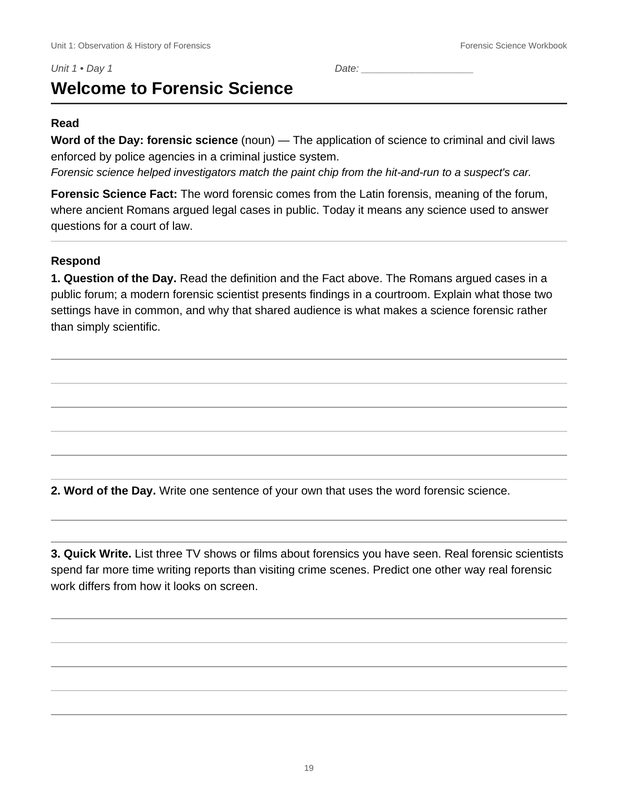
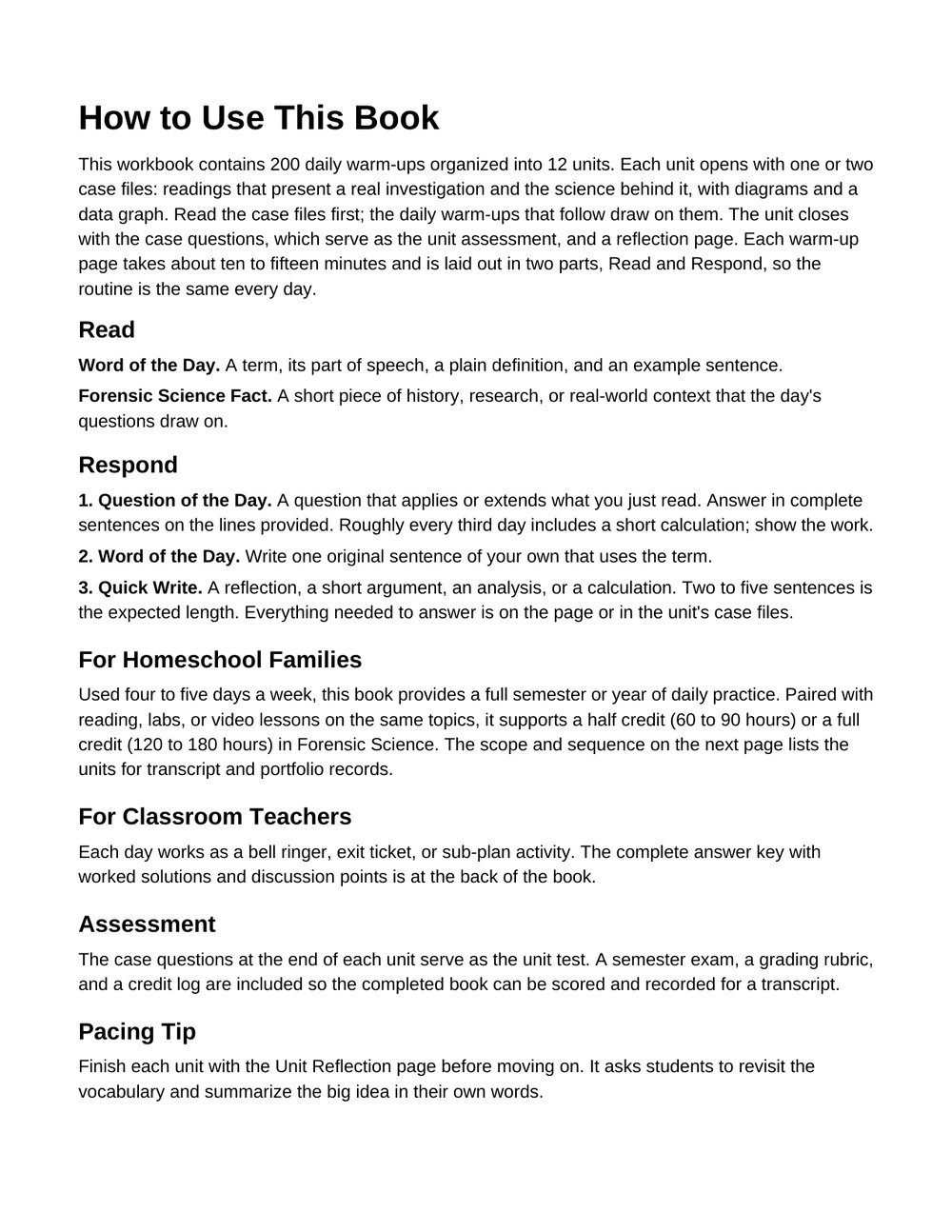
Every warm-up has the same two steps. Read the Word of the Day and the Fact; then respond to the Question of the Day, use the new word in a sentence, and write a short Quick Write. Ten to fifteen minutes. About every third day includes a calculation.
A Pre-Check before each unit and the case questions after it show what was learned. The answer key has model answers for every written question, a rubric for the Quick Writes, and a progress tracker and credit log for the transcript.
High School Science, Book 1
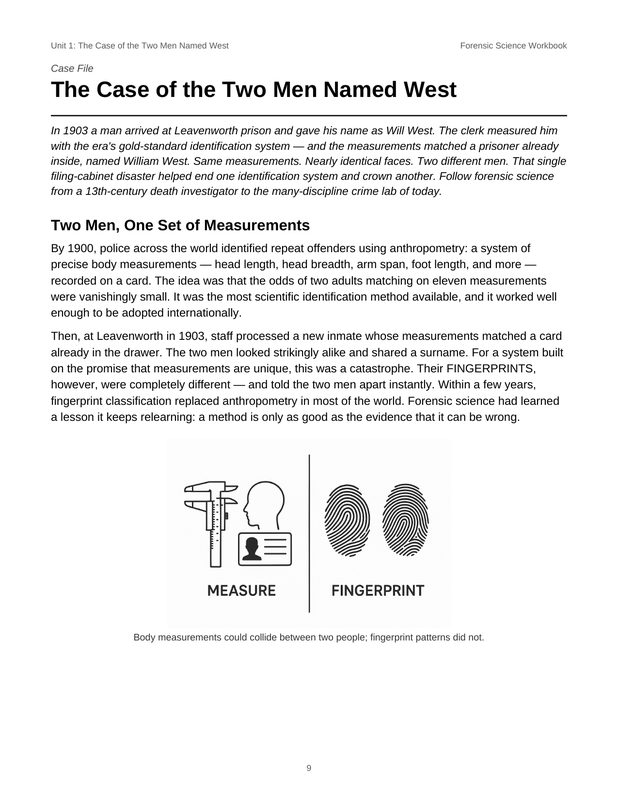
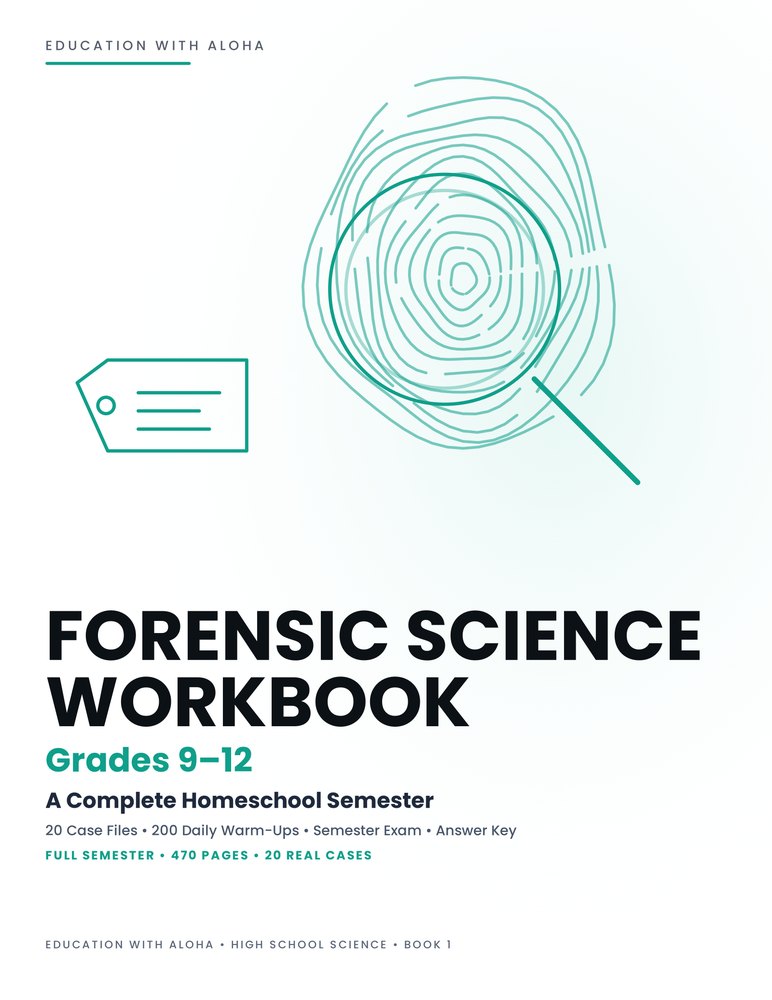
Twenty real cases, from the two prisoners named West who broke the Bertillon measurement system to the fire investigation that overturned decades of arson science. Each one teaches the evidence behind the headline: fingerprints, fibers, blood, DNA, toxicology, decomposition, bones, ballistics, documents, and arson.
Includes 20 self-grading online case assessments for book owners.
$32.99 · ISBN 979-8-16383-057-2 · Published October 2026
Taken from the book as printed. Click a page to read it at full size.
High School Social Studies, Book 1
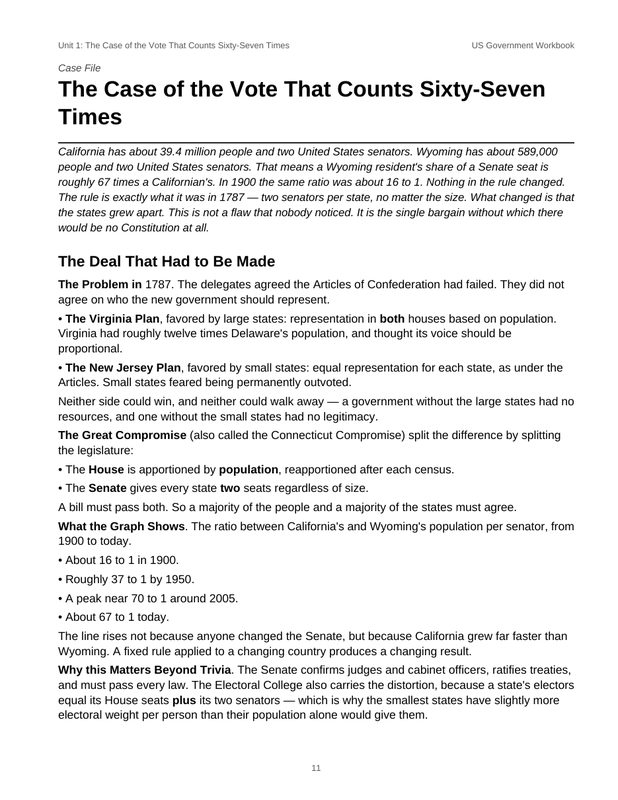
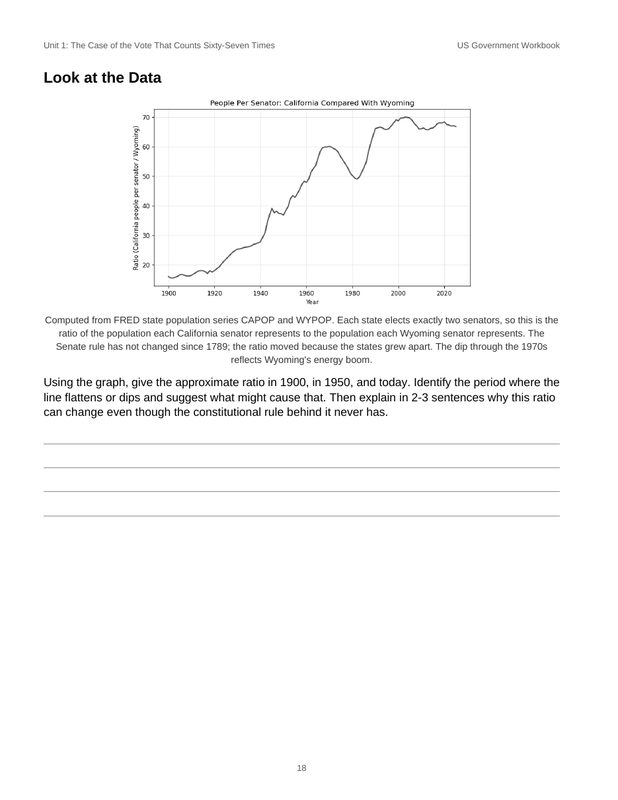
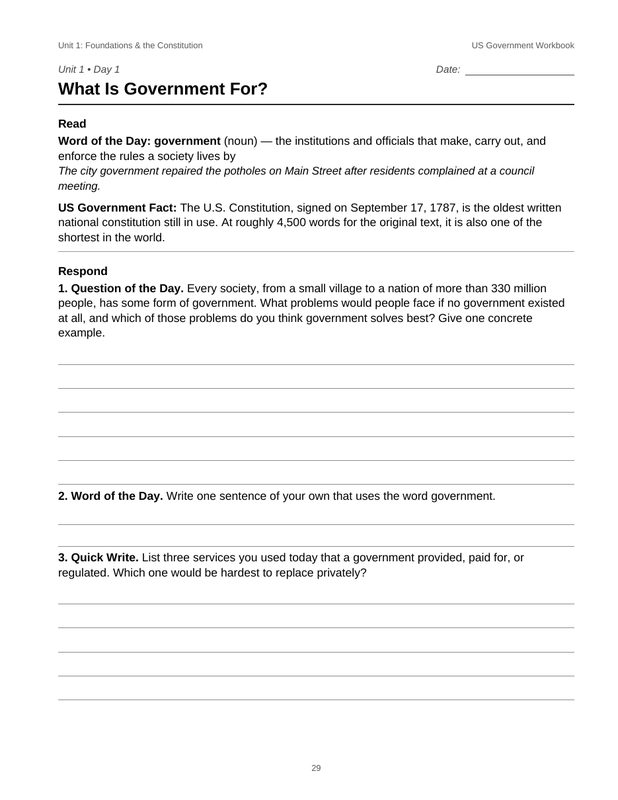
Every case file starts with a number that doesn't add up: the Senate vote that counts sixty-seven times, the bill that never got a vote, the 43 percent who call themselves independents but aren't. The data comes from the Senate's own records, the Federal Register, Gallup, and the Federal Judicial Center. The book reports what it shows, states the strongest argument on each side, and leaves the verdict to the student.
Includes 20 self-grading online case assessments for book owners.
$34.99 · ISBN 979-8-16451-751-9 · Published October 2026
Taken from the book as printed. Click a page to read it at full size.
High School Social Studies, Book 2
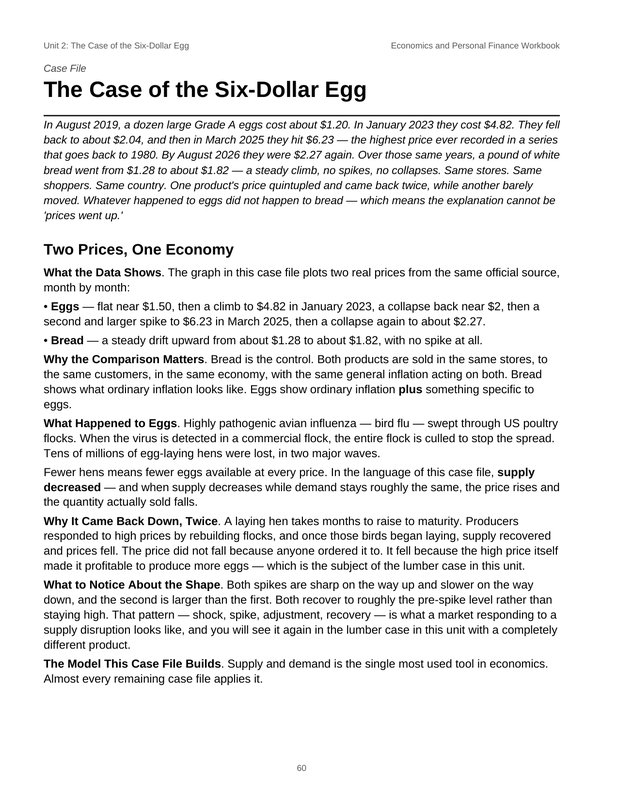
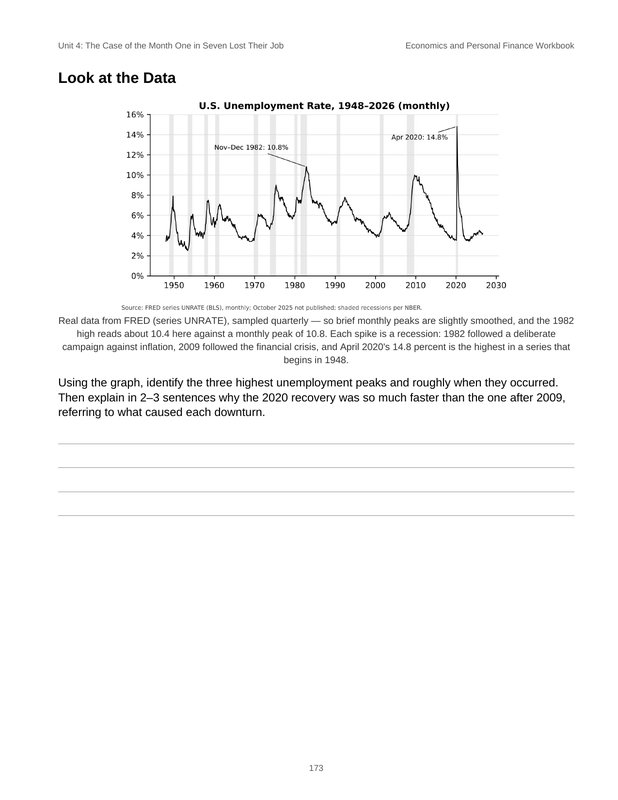
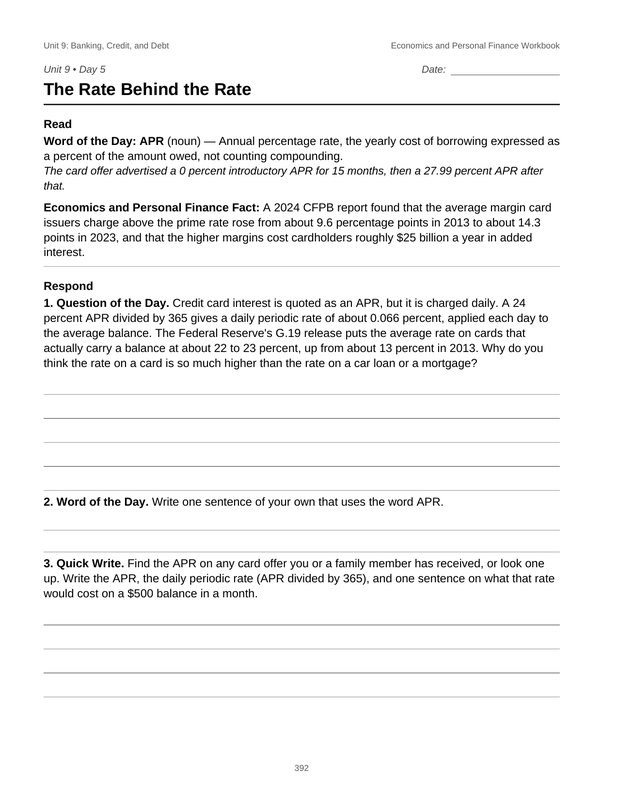
Every case file starts with a number worth explaining: the six-dollar egg, the lumber that tripled and then collapsed, the month one in seven Americans lost their job, the paycheck that shrank by a quarter before it arrived, the credit card that charged 24 percent. The first six units teach how the economy works; the last six turn it on the student's own life, from a first paycheck to a car loan, a credit score, and a retirement account. Where economists disagree, the book gives the strongest argument on each side and leaves the verdict to the student.
Includes 21 self-grading online case assessments for book owners.
$34.99 · ISBN 979-8-16661-272-4 · Published October 2026
Taken from the book as printed. Click a page to read it at full size.
The questions families ask most, answered from the books themselves.
Students in grades 9–12 who can read a high school text and work on their own. Forensic Science fits as a science elective. US Government covers the government course most high school transcripts include, and Economics and Personal Finance covers the economics and personal finance credit many states now require.
All three books also work for co-op classes and micro-schools, and as bell ringers in a classroom.
Very little. There is nothing to teach or prepare: the student reads the case file or the day's page and writes the answers.
Your part is checking the work against the answer key, which gives model answers and discussion points for every written question. Some parents check daily; others sit down once a week.
Four or five days a week, one warm-up page a day, about 10–15 minutes each. Each unit opens with one or two case files that take a longer sitting, and closes with the case questions (the unit test) and a reflection page.
Twelve units of about sixteen days each, with a Pre-Check before each unit and a semester exam at the end.
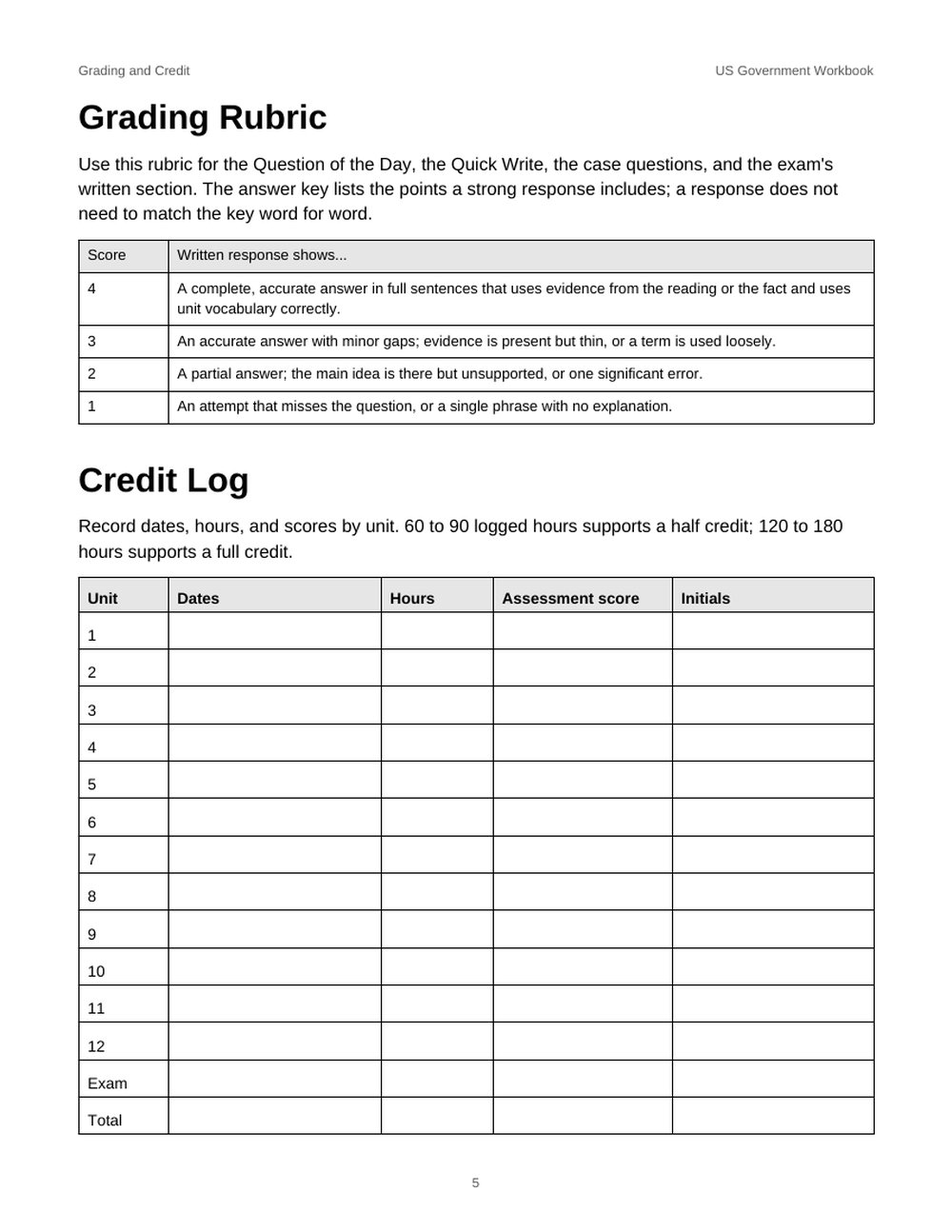
The book includes a 4-point rubric for written answers, a full answer key, a progress tracker, and a credit log for recording dates, hours and scores by unit.
On its own the book supports a half credit (60–90 hours). Paired with reading, labs or documentaries on the same topics, it supports a full credit (120–180 hours). The scope and sequence above is ready for a transcript or portfolio.
The book and a pencil. Everything needed to answer is on the page or in the unit's case files.
Internet is optional: the short Investigate It tasks point to primary sources, and book owners get free self-grading online versions of every case assessment.
All three books are secular and written for any family. US Government and Economics and Personal Finance report what the data shows, give the strongest argument on each side, and leave the verdict to the student.
Forensic Science is built on real criminal cases, including murders. The case files focus on the evidence and the science behind it, using diagrams and data graphs.
Education with Aloha is run by Pat Murphey, a high school science teacher on the Big Island of Hawaiʻi who has taught since 2011. The workbooks grew out of the daily warm-up routine he uses in his own classroom, and they're written for students who are working on their own: everything needed to answer is on the page or in the case file.
The same routine runs the Education with Aloha store on Teachers Pay Teachers, where the bell ringers, video guides, and lab activities are used by tens of thousands of teachers.
Questions about the books, review copies for reviewers and co-ops, or bulk orders for micro-schools:
Education with Aloha LLC
Keaʻau, Hawaiʻi